> For the complete documentation index, see [llms.txt](https://support.tiger.com/llms.txt). Markdown versions of documentation pages are available by appending `.md` to page URLs; this page is available as [Markdown](https://support.tiger.com/english/windows/chart.md).
# Chart
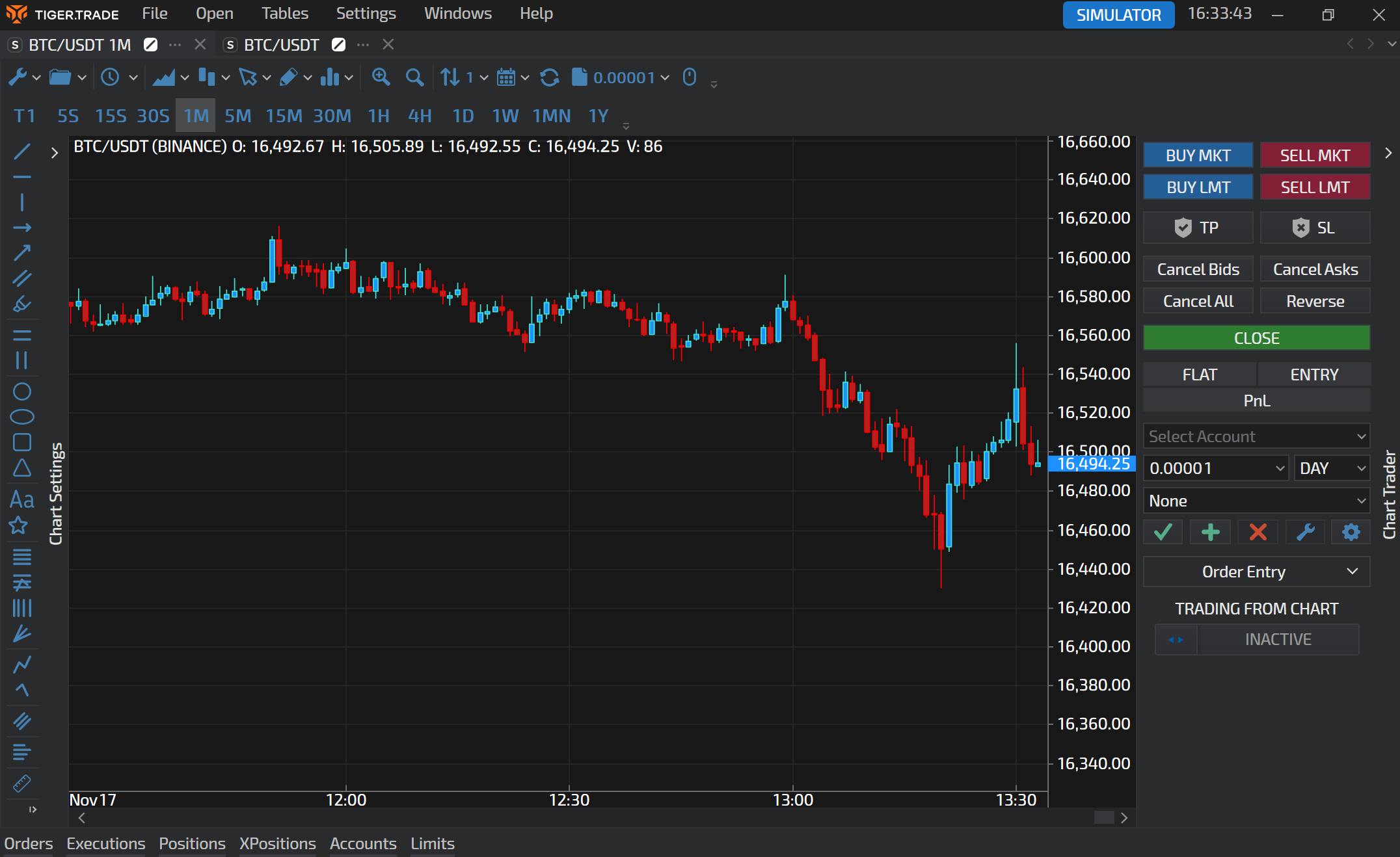
The Tiger.com Windows Terminal has a Chart window that features multiple chart types, settings and a fully functional trading panel.
The Charts window displays the **chart** of the selected instrument. You can draw graphical objects and add indicators to the chart. You can choose the type of chart: candles, bars, line, area, or clusters. The chart can be built not only with a time interval, but also based on ticks, volume, delta, or with a selected range (range chart).
To open a new chart, select **Open** → **Chart in the main menu**.
The **Charts** window includes:
* Main toolbar
* Drawing toolbar
* Chart settings toolbar
* Trading-from-chart toolbar
* Chart area
* DOM area
* Scroll bar
## Main toolbar
Using the main toolbar, you can:
* Open the settings and options menu
* Select a symbol
* Select a chart period
* Switch the chart view
* Select a cluster preset
* Select a cursor type
* Open the graphical objects menu
* Select an indicator
* Select order volume
* Zoom in, zoom out, or reset the chart scale
* Change the price scale (increase the price step by a given number)
* Set the beginning of the schedule to the date selected in the calendar.
* Refresh chart data
* Activate mouse trading on the chart.
## Timeframe toolbar
On the timeframe toolbar, you can select the time interval that will correspond to a single bar or candle on the chart. You can move the toolbar around by going to Period menu and selection of the desired position in the dropdown menu **Time frame bar**.
Available intervals:
* T1: 1 tick
* 5S: 5 seconds
* 15S: 15 seconds
* 30S: 30 seconds
* 1M: 1 minute
* 5M: 5 minutes
* 15M: 15 minutes
* 30M: 30 minutes
* 1H: 1 hour
* 4H: 4 hours
* 1D: 1 day
* 1W: 1 week
* 1MN: 1 month
* 1Y: 1 year
## Drawing toolbar
The drawing toolbar contains the main graphic objects, the magnet mode, and a function to block all objects. You can also hide all objects by clicking the icon below.

## Chart settings toolbar
The chart settings toolbar contains most of the chart settings and is divided into three tabs: basic settings, cluster settings, and trading settings.
You can save and load chart templates through the chart settings toolbar. The chart template includes all settings, including indicators and graphical objects.
You can enable the chart settings toolbar in the following ways:
* In the main chart toolbar, select **Options** → **Chart settings**.
* Right-click on the chart area and select **Chart settings**.
To collapse or expand the chart settings toolbar, click on the words **Chart settings** in the left part of the toolbar. To close this toolbar, click on the **Close button** in the lower part.

## Trading-from-chart toolbar

The trading from chart toolbar allows you to complete trading operations through the Charts window.
Enable/disable the trading-from-chart toolbar in the main chart toolbar can be accomplished by the following methods:
* Select **Options → Chart Trader.**
* Right-click on the chart area and in the menu that opens select **Chart Trader.**
To collapse or expand the chart settings toolbar, click on the words **Chart Trader** in the right part of the toolbar. When the toolbar is collapsed, all trading functions are saved. If the toolbar is closed, all trading functions are disabled.
## Chart area
The chart area displays the instrument chart itself with the selected indicators, along with the histogram for the selected period.
**By right-clicking on the chart area, you can proceed to the next menu:**

## DOM area
A dynamic DOM is displayed in the DOM area.

## Scroll bar
The chart scroll bar is located below the chart area. It allows you to scroll through the chart using a mouse.
---
# Agent Instructions
This documentation is published with GitBook. GitBook is the documentation platform designed so that both humans and AI agents can read, navigate, and reason over technical content effectively. Learn more at gitbook.com.
## Querying This Documentation
If you need additional information that is not directly available in this page, you can query the documentation by asking a question.
Perform an HTTP GET request on the following URL with the `ask` and `goal` query parameters:
```
GET https://support.tiger.com/english/windows/chart.md?ask=&goal=
```
`ask` is the immediate question: it should be specific, self-contained, and written in natural language.
`goal` is what the user is ultimately trying to achieve, the reason they need the answer. Sharing it helps GitBook give you a better, more relevant answer. A goal is most helpful when it describes the outcome the user wants rather than restating the question. For example, with `ask=how do I create an API token`, a goal like `automate deployments from our CI pipeline` lets GitBook tailor the answer to that use case.
The response will contain a direct answer to the question and relevant excerpts and sources from the documentation.
Use this mechanism when the answer is not explicitly present in the current page, you need clarification or additional context, or you want to retrieve related documentation sections.